Preserving the Community Banking Business Model
“Preserving the Community Banking Business Model”
Keynote Remarks before the
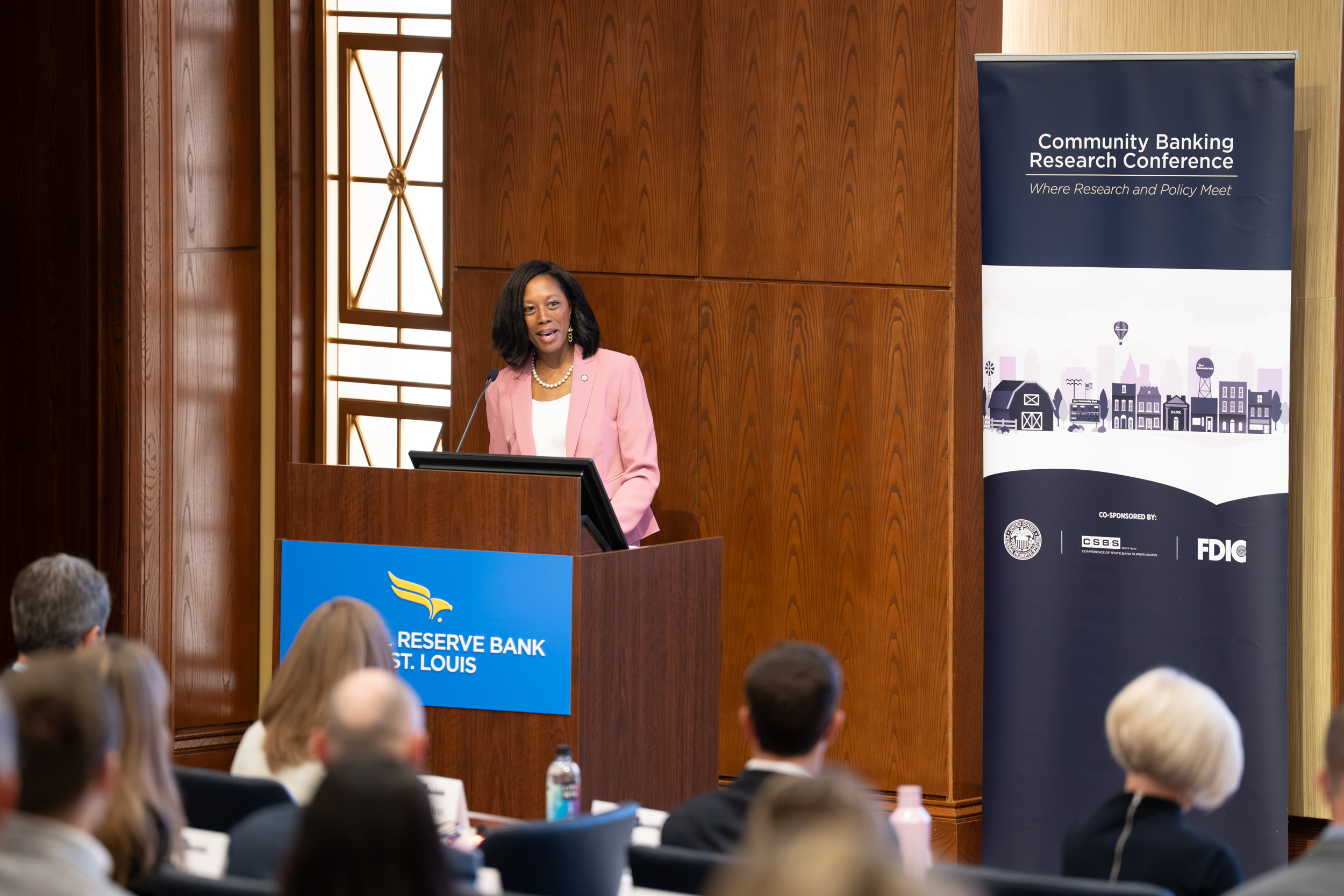
Community Banking Research Conference
by
Brandon Milhorn
Conference of State Banks Supervisors
President and CEO
Oct. 7, 2026
Thank you, Jim. It is such a pleasure to be here.
I want to thank our partners at the Federal Reserve and FDIC. Their partnership with state supervisors, on display here today in St. Louis, does not stop at these conference room doors. It extends to every state-chartered bank in the United States. From meetings like this to every bank exam, our work together makes the financial system stronger, strengthens the safety and soundness of our nation’s banks, and provides the credit that allows businesses to grow and consumers to live and thrive.
And finally, a special thanks to the researchers, regulators, bankers, and other participants who make this conference such an important forum.
The Community Banking Research Conference occupies a special place in our policy discussions. It brings rigorous research together with practical experience. It connects what happens in communities and bank offices across the country with the decisions made by regulators and policymakers in state capitals and Washington, D.C.
That connection matters.
Banking policy can sound very technical. We debate capital frameworks, supervisory authorities, chartering powers, preemption standards, branching laws, and payment systems. The list goes on and on. All are exceedingly technical topics, but they each have real-world, practical effects. They define how institutions compete, where capital flows, and whether consumers and small businesses can continue to choose a bank that knows them and their community.
So today, I want to focus on the dual banking system – not as an “org chart” or as an element of history – but as a living, breathing framework for the future of community banking.
At its core, strengthening the dual banking system is about preserving the community banking business model.
That means ensuring community banks have meaningful charter choice, regulation proportionate to their risks, and a level playing field as technology, competition, and policy choices reshape financial services.
The dual banking system matters because community banking matters. And if we allow the foundations of the dual banking system to erode, we should not be surprised if the community banking model erodes with it.
What We Are Fighting to Preserve
Before turning to specific policies, it is worth asking what exactly we are trying to preserve.
Community banking is not simply banking conducted by a smaller institution. It is a distinct business model.
It is built on relationships, local knowledge, and the informed exercise of judgment. A community banker may know the local employer seeking to expand, the farmer managing an unpredictable season, the entrepreneur opening a second location, or the family trying to buy its first home. The community bank understands not only the balance sheet in front of it, but also the economic context surrounding it.
Yesterday, CSBS Chair Rhoshunda Kelly also shared her observations on the importance of relationship-based banking.1 But don’t take our word for it; the research from our Community Bank Case Study Competition winning team – Tennessee Tech – spells it out in detail.2
That banking relationship . . . that local knowledge . . . matters most when a borrower does not fit neatly into a standardized box. Relationship banking adds human judgment to financial information. It can identify opportunities where a distant or fully automated process sees only an exception or too much risk. Community bankers help convert that local knowledge into productive credit for small businesses, farmers, and households.3
This resource-intensive, relationship-driven model depends on experienced bankers having time to understand customers rather than constantly absorbing complexity created elsewhere. That is why the policy, regulatory, and supervisory environment matters so much to the future competitiveness of community banks.
Community banks cannot preserve relationship banking if unnecessary or unwarranted compliance obligations consume the people, time, and capital that should be serving customers. These banks cannot compete if new entrants perform bank-like activities without bank-like safeguards and equivalent compliance obligations.
And state-chartered banks lose meaningful charter choice if federal policy steadily makes the state charter less competitive.
The question before us is not whether banking will change. It has . . . and it will continue to evolve. The question is whether community banks will have a fair opportunity to shape that future and remain a crucial part of the United States financial system that emerges.
Three principles should guide us: tailored regulation and supervision, competitive parity between state and federal charters, and interstate banking rules that foster a digital economy.
Tailored Regulation Is Sound Regulation
Let me begin with tailored regulation and supervision. Tailoring is sometimes presented as a choice between strong and weak oversight. That is a false dichotomy. Strong regulation does not require unduly burdensome, one-size-fits-all requirements. The question is whether our regulatory environment is appropriately calibrated to an institution’s actual risk, complexity, and business model.
The evidence tells us why tailoring is vital.
Compared to the largest institutions, the smallest banks are often devoting roughly twice the share of their operating expenses to compliance obligations. A recent analysis drawing on 10 years of data from the CSBS Annual Survey of Community Banks found that smaller banks consistently devote a disproportionately large share of their resources to personnel, data processing, accounting, auditing, and consulting expenses attributed to compliance.4
Those costs can fundamentally change how community banks operate . . . and ultimately, how they serve their communities. An unduly burdensome compliance obligation may force a community bank to delay a technology upgrade, reduce a product offering, or hire another costly consultant or lawyer . . . instead of bringing on another lender.
The application of a rule to a larger institution may be identical on paper, but its effects are often far from identical in practice at smaller banks.
This unnecessary regulatory burden is a competitive force: as fixed costs rise, scale becomes more vital, and growth or consolidation becomes a matter of survival. Far too often, communities lose access to local banks as a result.
That is why state supervisors have advocated for durable, tailored banking regulation for decades. They have seen first-hand the impact of one-size-fits-all, overly burdensome compliance obligations on their state-chartered banks. They have witnessed the steady decline in the number of community banks. They have felt the financial consequences those losses have on their communities.
The same considerations apply to how banks are supervised. Hyper-technical, checklist-focused supervision can place unnecessary burdens on banks of all sizes. That is why the Federal Financial Institutions Examination Council’s (“FFIEC”) proposed modernization of the CAMELS rating system is an important opportunity.
Through the FFIEC’s State Liaison Committee, state supervisors have participated directly in this important effort to improve the CAMELS system. The State Liaison Committee’s vote on the FFIEC reflects an essential feature of the dual banking system: state supervisors are not passive observers of national supervisory policy. Through the FFIEC and their partnerships with the Federal Reserve and FDIC, they help develop and execute it.5
Using CAMELS, examiners evaluate relative risks in a bank’s capital, asset quality, management, earnings, liquidity, and sensitivity to market risk. The ratings system provides a “common baseline for federal and state supervisors to assess the safety and soundness of United States financial institutions and to communicate those findings consistently.”6
Combined with a comprehensive Report of Examination, the CAMELS framework helps focus supervisory attention on institutional risks, provides clear supervisory expectations, and gives a bank’s board and management the opportunity to intervene and mitigate material financial risks and significant compliance, governance, and risk management deficiencies. Congress has even incorporated the ratings into laws that can affect a bank’s ability to grow and serve customers.7
But CAMELS has not undergone a comprehensive revision in roughly 30 years.
The FFIEC’s CAMELS proposal takes important steps in the right direction. It would tie ratings more closely to actual safety and soundness, focus on material financial risks, improve transparency, and reduce the chance that overly technical process concerns overwhelm the critical evaluation of a bank’s financial condition, compliance obligations, and prudent risk management.
These important CAMELS updates should not come at the expense of critical supervisory judgment. Banking is not mechanical, and CAMELS should not prevent an experienced examiner from recognizing an emerging risk simply because it has not yet produced a measurable loss.
The goal of tailoring should be disciplined, transparent, and accountable discretion: ratings grounded in material financial and significant compliance and governance risks, clearly explained and consistently applied, while accounting for each institution’s size, business model, and risk profile.
These reforms must maintain that careful balance to be meaningful . . . and durable.
This durability is critical, because community banks pay a price not only when regulation and supervision are excessive, but when expectations swing sharply from one administration to the next. Each dramatic turn of the pendulum requires banks to reinterpret expectations, revise policies, retrain employees, modify systems, and redirect management attention. Every regulatory shift imposes costs – even those designed to reduce burden. And doubly so, if banks cannot rely on those policy changes to survive through the next election.
Durability does not mean bank oversight should never evolve. It means reform should rest on evidence, sound statutory bases, and the core principle of safety and soundness – not the politics of the moment. A durable framework gives supervisors room for judgment and banks enough certainty to make long-term decisions.
The tailoring objective should be straightforward: finalize sensible CAMELS reforms, preserve appropriate supervisory discretion, and protect safety and soundness without diverting limited community-bank resources away from customers and local lending.
That is not weaker oversight. It is smarter, more stable, and ultimately, more effective regulation.
Maintaining Competitive Balance in a Digital Economy
That brings me to charter parity.
Seventy-nine percent of U.S. banks have chosen a state charter.8 The vast majority are community banks. They choose the state system because of its local perspective, accountability, and supervisory expertise that understands the markets they serve.
But charter choice is meaningful only if state and national banks can compete on equitable terms.
A bank should choose its charter because that supervisory framework best fits its business model – not because an accumulation of policy choices has made one charter structurally more valuable than the other.
That accumulation . . . that thumb on the competitive scale . . . is the risk.
The dual banking system is unlikely to be weakened by one dramatic act. Erosion will occur one small policy decision at a time: a question about how an interstate loan is treated; a preemption determination affecting one state’s consumer protection law; a regulation that ties a state bank’s authority to the location of a physical branch. Each decision may appear narrow in isolation. Together, they gradually change the competitive value of the state charter.
We can see that dynamic in current debates involving federal preemption, the Depository Institutions Deregulation and Monetary Control Act of 1980 (“DIDMCA”), and the interstate banking framework established by Riegle-Neal.9
Each involves a different statute and a different legal question. And each can be addressed in a manner consistent with both the law and a balanced dual banking system.
Federal preemption, for example, has a legitimate, but appropriately narrow role. When a state law “prevents or significantly interferes” with a national bank’s exercise of its lawful powers, Congress has provided a standard and process that allows for targeted preemption. Those principles, embodied in the National Bank Act, ensure that federal intrusions on state authority are grounded in law and careful, transparent analysis – not broadened in ways that unnecessarily tilt the competitive playing field for national banks or make the high-bar for preemption virtually meaningless.10
Now, when a state law is preempted for national banks under careful application of that narrow standard, the Riegle-Neal Act provides that the law should also be preempted for out-of-state state-chartered banks.
In September, the FDIC proposed a rule on bank parity that would modernize its regulations to recognize the increasingly digital delivery of banking services.11 When a state law is lawfully preempted for national banks, the FDIC’s rule would extend preemption to out-of-state state-chartered banks regardless of physical presence, consistent with the intent of Riegle-Neal.
That is how charter parity should work: state-chartered banks are allowed to engage in interstate activities under standards comparable to those that apply to national banks, while state authority over their own state-chartered institutions is preserved.
Like Riegle-Neal, DIDMCA was enacted to promote competitive equality between state-chartered and national banks in interstate lending, while preserving a state’s authority to opt out of that framework.12 Interpreting the DIDMCA opt-out to govern banks chartered by the “opt-out” state respects state sovereignty, while maintaining the interstate parity Congress intended for banks chartered in other states.13
These are not arguments for predetermined outcomes in every case. They are arguments for keeping charter parity at the center of the analysis, protecting the overall value of the state charter, and preserving the authority of each state over its own charters.
Those principles matter more as banking becomes increasingly digital.
A customer may open an account from their phone, move to another state without changing banks, or operate a business across several jurisdictions. A locally rooted community bank may serve customers whose lives and businesses extend well beyond the bank’s physical footprint. The relationship remains real even when the geography becomes less obvious.
Large institutions can maintain branches across many states and spread legal and compliance costs across vast customer bases. Community banks cannot. If policy prevents a state-chartered community bank from following its customers or serving businesses across state lines on comparable terms to national banks, the legal framework becomes the binding constraint on the state-chartered bank’s relationships with its customers – and this relationship is the business model.
New technology will continue to change consumer expectations. Innovation will expand markets for community banks far beyond their local geography. But our laws and policies must provide a regulatory framework that supports a community bank’s ability to meet new consumer expectations and capture new markets.
Our nation’s policies on burgeoning markets, including digital assets, are one clear example. Will Congress recognize and adjust the law for the impact that deposit outflows to yield-bearing stablecoins could have on traditional lending from community banks? Will the OCC be allowed to authorize trust charters that engage in bank-like activities – well beyond any authority outlined in the GENIUS Act or the National Bank Act?
Decisions on topics like these have a real impact on your communities; on the cost-structures that allow your banks to compete fairly with new entrants; on the deposit bases that support new lending to small businesses and farmers; and, on the cost of capital and deposits that will sustain community banking.
No single decision will determine the future of the state charter, but the cumulative effect matters. A small disparity here, an additional restriction there, and a broad, unlawful assertion of federal authority somewhere else, can slowly erode legitimate charter choice.
Ensuring that community banks can compete effectively . . . in their local communities and across state lines . . . is essential to their future.
And, real charter choice requires more than preserving two chartering authorities on paper. It requires sustained attention to the balance between them – one policy decision at a time.
A Research Agenda for the Future of Community Banking
We established this conference because there was insufficient research about the role and importance of community banks in the nation’s economy. Fourteen years later . . . working with our partners at the Federal Reserve and FDIC . . . the research produced at this conference has helped close this gap. This week, we have built on that foundation, but there is more work that must be done.
We need research that helps policymakers see the community banking model as a system rather than a collection of isolated issues.
We must measure the cumulative cost of regulation, not simply each rule in isolation, and study how compliance demands affect staffing, technology investment, product offerings, and lending.
We must study charter choice as an indicator of system health and ask what happens to local credit access when that choice narrows.
And we must test whether federal or state laws produce their intended outcomes in digital markets – or increasingly create barriers that fall hardest on smaller institutions.
Good research will not eliminate policy disagreements, but it can sharpen the analysis, expose hidden tradeoffs, and force us to confront the downstream consequences of well-intended decisions.
Most importantly, forward-looking research that informs sound policy can help us preserve the critical role community banks play in our financial services landscape . . . instead of asking too late which policies contributed to their demise.
Conclusion
Regulatory tailoring and the individual policy decisions that shape charter parity may appear to be separate debates. They are not.
Tailored banking policies that are grounded in a strong dual banking system allow for supervision that reflects tangible differences in risk and business models. They preserve state authority and true charter choice and enable local institutions to transform and thrive as their customers, markets, and technology evolve.
Preserving dual banking principles is not nostalgia.
It is not an effort to freeze banking in time or defend tradition simply because it is tradition.
It is a practical strategy for preserving community banking itself.
If we want locally informed credit decisions, we must maintain an environment in which local institutions can thrive.
If we want state-chartered banks to remain a source of competition and market efficiency, we must keep parity at the center of decisions involving preemption and interstate banking.
And if we want community banks to serve customers in a digital economy, we must apply interstate banking laws in ways that reflect how customers bank today.
The future of community banking will not be secured by resisting change. It will be secured by shaping change around durable principles: tailored regulation and supervision, fair competition, genuine charter choice, and respect for the role of the states.
Our responsibility is to make sure that balance remains real – not just in law, but in the daily competitive environment facing community banks.
That is how we strengthen the dual banking system.
And that is how we ensure community banks can continue doing what they do best: serving their customers, investing in their communities, and expanding opportunity across the country.
Thank you.
- 1
See Rhoshunda Kelly, Opening Remarks, Community Banking Research Conference (Oct. 6, 2026).
- 2
See CSBS, Tennessee Tech Earns Top Prize in CSBS Community Bank Case Study Competition (May 13, 2026); Tennessee Technological University, Analysis of Wilson Bank & Trust, CSBS Community Bank Case Study Paper (May 2026).
- 3
[Community banks comprise 92 percent of state-chartered banks and play a vital role in local economies. State-chartered banks represent approximately 33 percent of industry assets yet, provide 53 percent of all small loans to businesses and 67 percent of commercial bank agriculture lending. FDIC, BankFind Suite.
- 4
Smaller banks consistently spend a higher share on compliance costs as shown by the differences in operating expenses between the smallest and largest banks: (i) personnel costs (11-15.5 percent vs. 6-10 percent); (ii) data processing costs (16.5-22 percent vs. 10-14 percent); (iii) accounting and auditing costs (5-17 percentage points higher for the smallest banks); and (iv) consulting costs (50-64 percent vs. 19-30 percent). CSBS, Too Small to Scale: What 10 Years of Data Say About Community Bank Compliance Costs (Nov. 13, 2025).
- 5
State regulators are represented on the FFIEC through the State Liaison Committee (SLC), and the Chair of the SLC is a voting member of the FFIEC. See 12 U.S.C. §§ 3303, 3306.
- 6
CSBS, NASCUS, and ACSSS Joint Comment Letter re: Federal Financial Institutions Examination Council Request for Comment on Proposed Revisions to the Uniform Financial Institutions Rating System (Aug. 17, 2026).
- 7
CAMELS composite ratings are incorporated within several laws and regulations as eligibility thresholds and regulatory triggers. While not an exhaustive list, the Federal Deposit Insurance Act and implementing FDIC regulations use the ratings to determine deposit-insurance assessment ranges and inform restrictions or supervisory treatment for institutions that are not considered well rated. See 12 C.F.R. § 327.16. Similarly, the OCC factors CAMELS ratings into its fee assessments and imposes surcharges on banks with composite ratings of 3, 4, or 5. See 12 C.F.R. Part 8. The Gramm-Leach-Bliley Act requires specific CAMELS composite ratings for the depository institution subsidiaries when a firm seeks to become a financial holding company. See 12 U.S.C. §§ 1843(l), 1841(o)(9). Federal Reserve regulations and guidance also rely on composite ratings to determine access to Federal Reserve credit and payment system privileges. See, e.g., 12 C.F.R. § 201.4. Further, composite ratings may also factor in federal banking agency decisions regarding applications for opening branches or engaging in a merger or acquisition. See, e.g., SR 14-2/CA 14-1.
- 8
See FDIC, BankFind Suite.
- 9
P.L. Law 103-328 (1994).
- 10
See CSBS, Comment Letter re: Preemption Determination: State Interest-on-Escrow Laws and Real Estate Lending Escrow Accounts (Jan.29, 2026); CSBS, Comment Letter re: National Bank Non-Interest Charges and Fees (May 29, 2026). See also, Cantero v. Bank of America, N.A., No. 21-400, 36 (2d Cir. 2025) (Perez, M., dissenting) (“[O]ne can hardly imagine a component of bank decision making that, under the OCC’s reasoning, would not be deemed a broad and flexible national banking power. And if that were the case, that would preempt virtually all state laws that regulate national banks, contrary to the express directive of the Supreme Court that a more exacting preemption analysis is required.” (internal quotations omitted)).
- 11
See FDIC, Notice of Proposed Rulemaking, State Bank Parity (Sept. 22, 2026).
- 12
Section 525 of DIDMCA allows a state to “opt-out” of the interest rate exportation framework if the state “does not want [interest rate exportation] to apply with respect to loans made in such State.” Pub. L. 96-221 (1980). To date, Colorado, Iowa, Puerto Rico, and Oregon have opted out of DIDMCA. The scope of the DIDMCA “opt-out” is the subject of litigation in Colorado and Oregon. The central question currently being considered in the Tenth Circuit in National Association of Industrial Bankers v. Weiser is how to interpret where a loan is “made” under Section 525 when the state-chartered bank and borrower are in different states. In that case, Colorado argues the law applies to all loans made to borrowers located in Colorado. The challengers argue the law only applies to loans where the core lending functions (such as underwriting, approval, and funding) are taking place inside Colorado.
- 13
See CSBS, Letter to House Financial Services Committee re: American Lending Fairness Act of 2026 (Sept. 2, 2026).