Community Bankers Signal Economic Warning
By CSBS Chief Economist Thomas F. Siems, Ph.D.
Despite continued optimism about their own institutions, community bankers are increasingly concerned about monetary policy and future business conditions.
Community bankers have long served as a valuable barometer of economic conditions on Main Street. Their daily interactions with households, small businesses, and local employers provide a unique perspective on the health of the U.S. economy—often revealing emerging challenges before they become apparent in national economic statistics.
The latest Community Bank Sentiment Index (CBSI) from the Conference of State Bank Supervisors (CSBS) offers a particularly interesting message: Community bankers remain confident in their own institutions, but their confidence in the broader economic outlook is deteriorating.
As shown in Chart 1, the third-quarter 2026 CBSI fell nine points to 120, marking its fourth consecutive quarterly decline. The index has now fallen 13 points from its reading of 133 one year ago. Although the latest reading remains comfortably above the neutral level of 100, the direction and composition of the decline warrant attention.
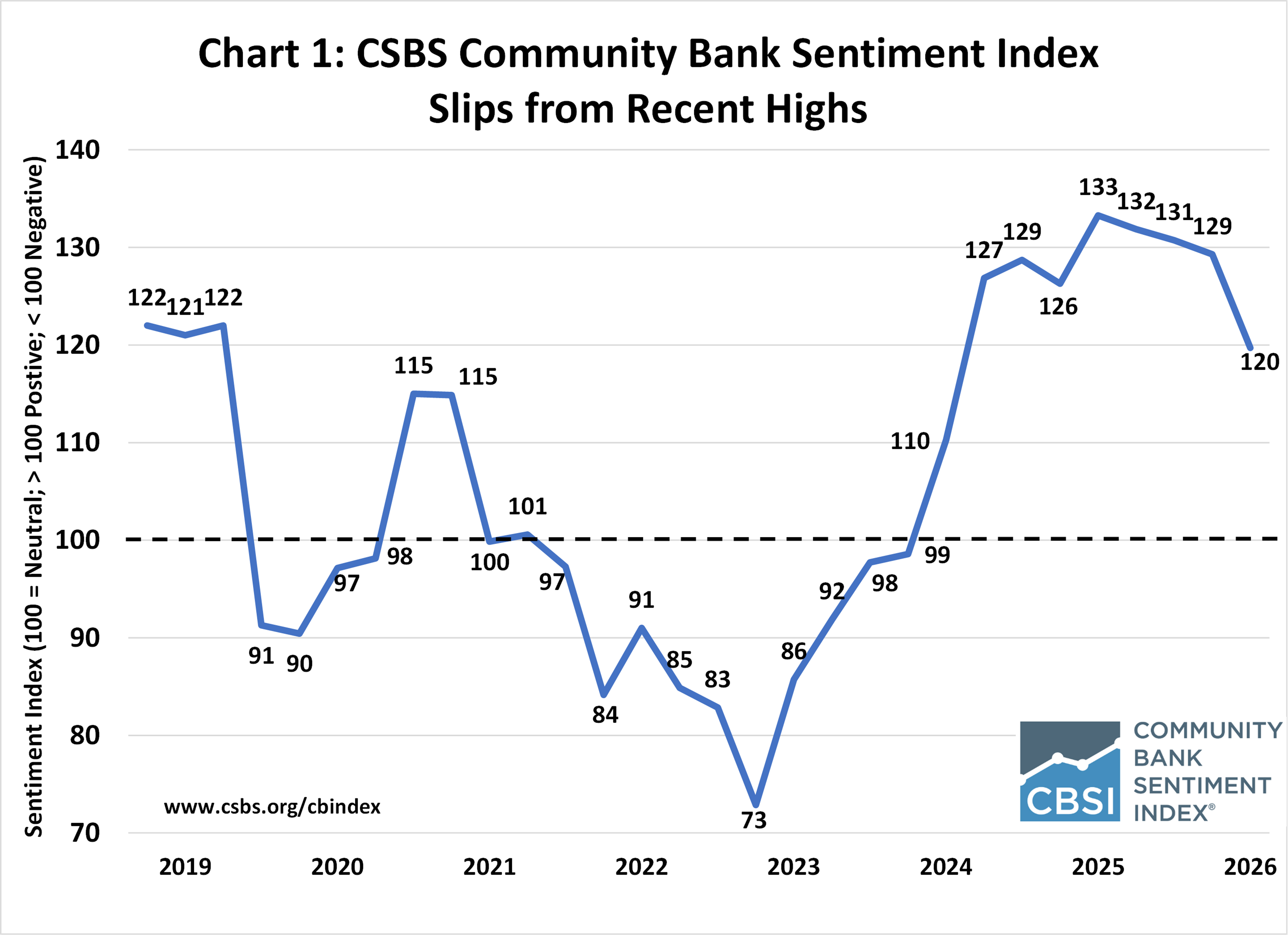
Indeed, the nine-point drop represents the fifth-largest quarterly decline in the survey's history. Six of the seven components fell during the quarter, with particularly sharp declines in expectations for monetary policy, business conditions, and profitability.
The message is not that community bankers have abandoned optimism. Rather, they are becoming increasingly concerned about the economic environment in which they must operate.
Monetary Policy: From Optimism to Apprehension
Perhaps the most striking development in the latest survey is the dramatic deterioration in bankers' expectations for how monetary policy might impact their local markets.
As shown in Chart 2, the CBSI monetary policy component plunged 26 points to 70 in the third quarter, following an 11-point decline in the previous quarter. Just one year ago, the index stood at an all-time high of 130. In only four quarters, sentiment toward monetary policy has fallen an extraordinary 60 points.
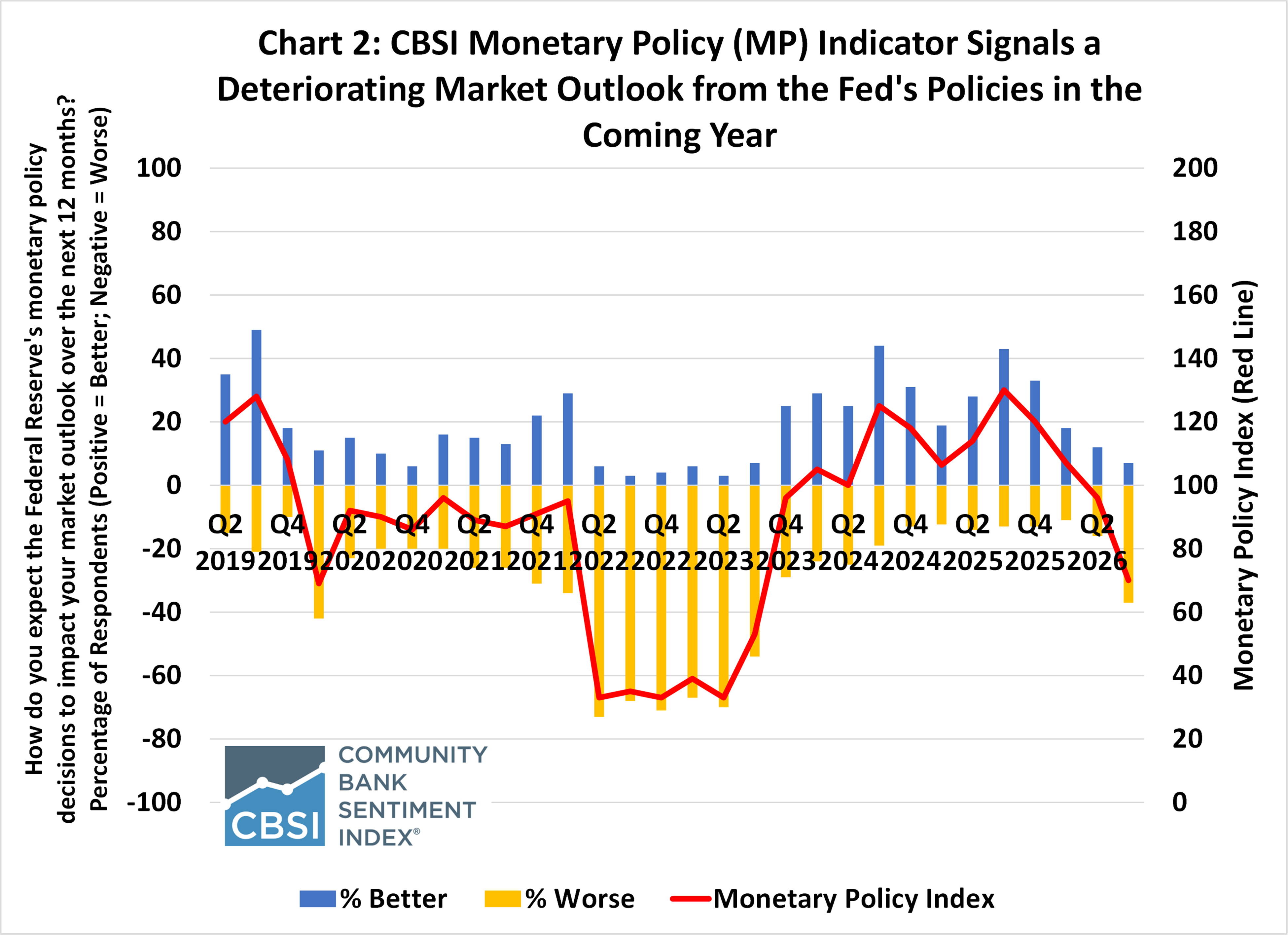
The current reading is the lowest since the third quarter of 2023, when the Federal Reserve raised its target federal funds rate to a range of 5.25% to 5.50%.
Why the dramatic reversal?
Community bankers face a complicated monetary policy environment. Persistent inflationary pressures, elevated borrowing costs, and uncertainty about the future direction of interest rates create challenges for both bank balance sheets and the customers they serve.
For community banks, interest rates affect far more than the cost of borrowing. They influence deposit pricing, net interest margins, securities valuations, loan demand, and the ability of small businesses and households to finance new investments.
Moreover, monetary policy operates with long and variable lags. Decisions made today may not fully affect economic activity for several quarters. This makes an uncertain interest rate outlook particularly challenging for institutions whose business models depend on long-term customer relationships and prudent balance sheet management.
The steep decline in the monetary policy index suggests that bankers are becoming increasingly uncomfortable with the outlook for interest rates and inflation. Whether their concerns ultimately prove justified remains to be seen, but the magnitude of the change deserves attention.
Business Conditions: A Persistent Source of Concern
The deterioration in expectations for future business conditions is equally noteworthy.
Chart 3 shows that the CBSI business conditions component declined 16 points to 83 in the third quarter, down from 99 in the previous survey. A reading below 100 indicates that more bankers expect economic conditions to deteriorate than improve over the coming year.
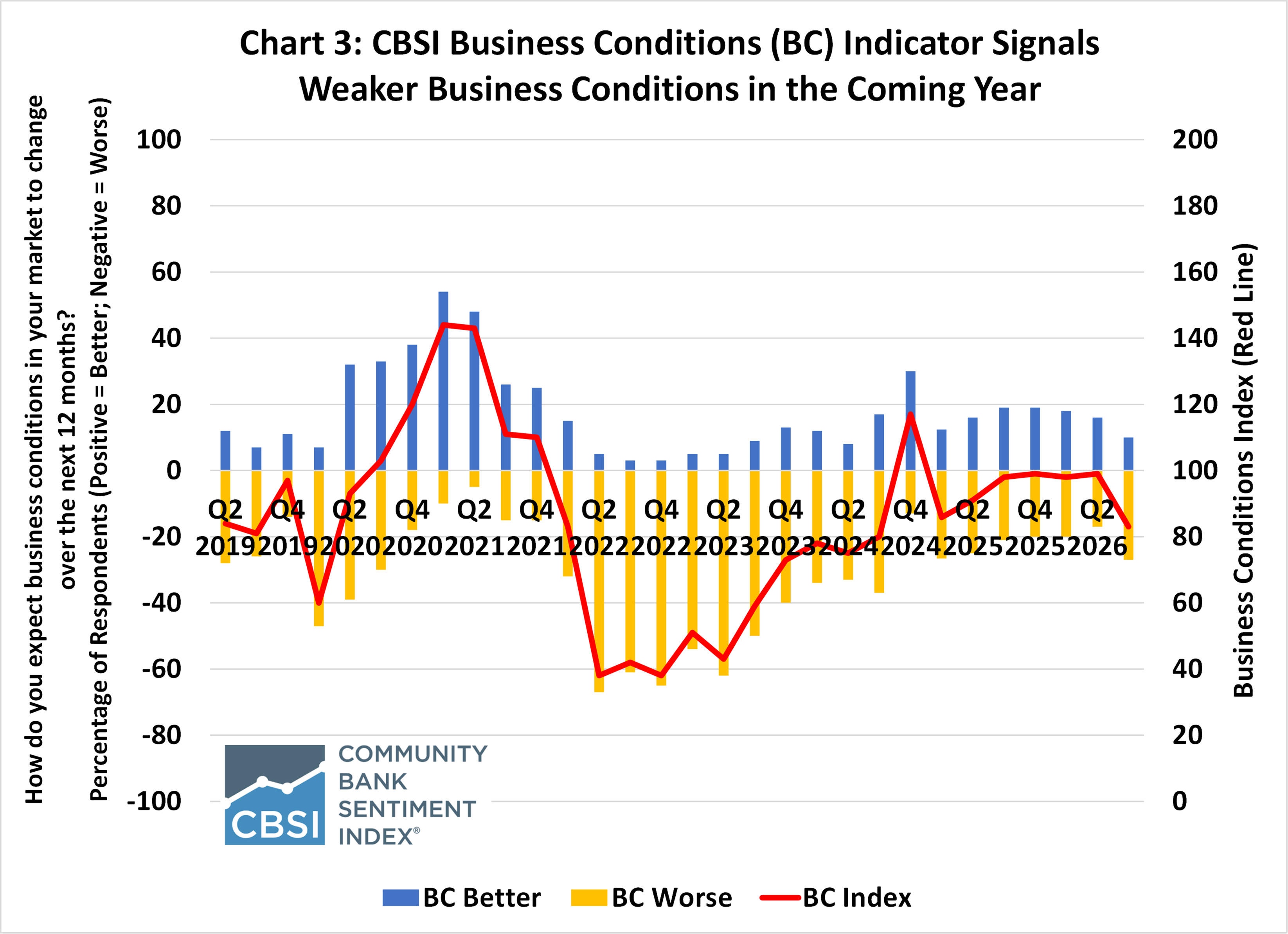
Perhaps even more revealing is the persistence of this pessimism. Since 2021, the business conditions index has exceeded the neutral threshold of 100 only once, reaching 117 in the fourth quarter of 2024.
In other words, despite periods of relatively strong economic growth and continued resilience in labor markets, community bankers have remained skeptical about the durability of the expansion. That skepticism is also evident in responses to a special survey question about the current stage of the business cycle. Nearly half—49%—of respondents believe the U.S. economy is either entering or already experiencing a recession, up from 41% in the previous quarter. Meanwhile, 30% believe the economy is experiencing solid growth, and another 21% believe it is at the beginning of an expansion.
These responses do not establish that a recession is underway. Rather, they reveal a meaningful divide in perceptions of the economy and underscore the uncertainty confronting businesses and lenders.
Community bankers are particularly well positioned to observe economic conditions at the local level. Their perspectives reflect conversations with business owners, changes in credit demand, and evolving financial conditions across communities that may not always be fully captured by aggregate economic data.
A Tale of Two Outlooks
What makes the latest CBSI especially interesting is the contrast between bankers' concerns about the economy and their confidence in their own institutions.
Despite declining 16 points, the profitability component remains at a relatively strong 138. The operations expansion index stands at 136, while the capital spending component actually increased four points to 145. Most strikingly, the franchise value component remains exceptionally strong at 160, even after a modest five-point decline. These readings suggest that community bankers continue to see considerable strength in their institutions and their long-term prospects.
This apparent disconnect is not necessarily contradictory.
Bankers can remain confident in their ability to serve customers, manage risks, and grow their institutions while simultaneously recognizing growing economic headwinds. Indeed, the contrast may reflect the resilience of the community banking business model. Strong customer relationships, local market knowledge, and disciplined risk management can support confidence in an institution's future even when the broader economic outlook becomes more uncertain.
Uncertainty Is Becoming a Defining Feature
The latest survey also reveals several sources of concern beyond monetary policy and business conditions.
In their written comments, bankers cited inflationary pressures, geopolitical tensions, persistently high oil prices, the growing federal debt, political uncertainty surrounding the midterm elections, and increasing fraud.
The CBSI Uncertainty Index rose two points to 27, reinforcing the view that uncertainty is becoming more prevalent.
Bankers also identified cyberattacks, bank fraud, the federal debt and deficit, labor costs and availability, and competition as their five leading concerns—the same five issues identified in each of the previous five quarterly surveys.
These are not isolated worries. They represent a combination of structural challenges and cyclical pressures that could influence community banking for years to come.
What Should We Take Away?
The third-quarter CBSI offers an important reminder that economic sentiment is rarely captured adequately by a single number.
At 120, the overall index continues to signal optimism. But beneath that headline, community bankers are expressing substantially greater concern about monetary policy and the future direction of the economy.
The divergence between strong confidence in their own institutions and weakening expectations for the broader economy may be the most important finding in this quarter's survey. Community bankers are not predicting an inevitable downturn, nor should their concerns be interpreted as a recession forecast. But their increasingly cautious outlook deserves attention.
The bottom line: Community bankers remain optimistic about their own future, but they are becoming much less confident about the economic road ahead.